
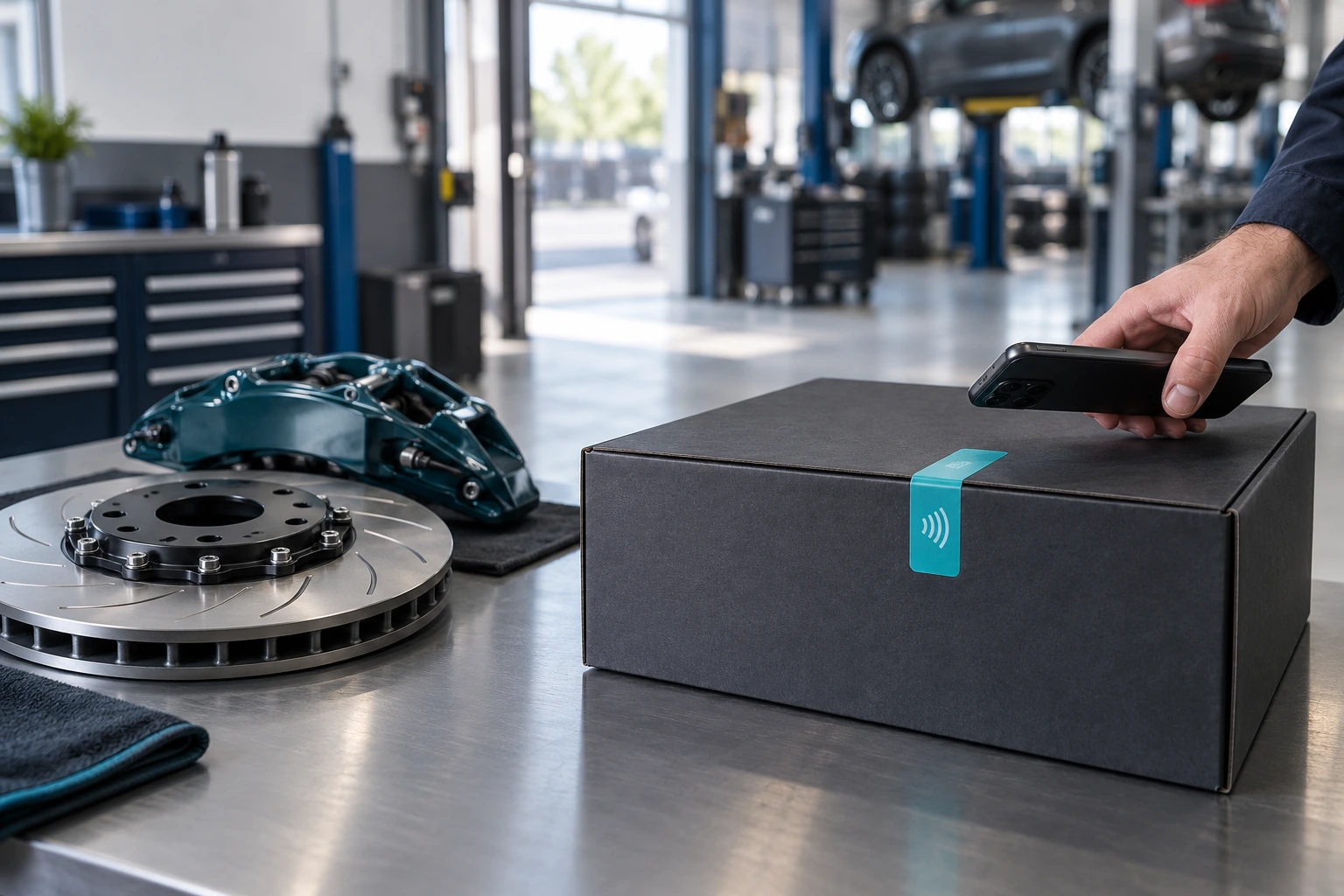
A performance brake upgrade kit arrives at a workshop, ready for a customer's fitting appointment. The packaging carries the expected branding and model details. Before the work begins, though, the fitter needs to establish a few things: is this the kit the brand supplied, does it match the order, and are the correct components all there?
For a parts manufacturer, those questions arise further from the factory as products pass through distributors, tuning specialists and workshops. The brand knows what it made and supplied. The buyer may have no easy way to consult that information. Effective automotive parts authentication gives buyers something to check against, beyond the appearance of the box.
BrandGuard can support that process with secure NFC tags, online verification and product information pages for buyers. The starting point is choosing where these checks will be most useful. A brake upgrade kit then provides a practical example of how the service works and what it can deliver.
Which automotive parts should a brand consider first?
Performance brake kits, turbochargers and common-rail diesel injectors are useful candidates to assess. Each has a defined brand and specification, and fitting involves time and expense. Discovering a questionable source or an incorrect model after installation makes the problem harder to resolve. Alongside the selling price, consider the brand's reputation, distribution channels, the cost of rework and whether buyers can check the packaging before fitting.
Brake products already have established authentication schemes. For example, Brembo's official identification guide describes using the Brembo Check app to scan a unique QR code for UPGRADE products. This is a QR-based scheme, demonstrating a practical role for buyer verification in this category.
Other manufacturers have documented counterfeit parts too. BorgWarner reported in 2020 that counterfeit turbos copied branding, identification numbers and packaging. DENSO reported a 2021 court case against sellers of counterfeit diesel injectors. These are independent industry examples, not BrandGuard customer projects or evidence that the manufacturers use our NFC service.
A genuine caliper does not establish the origin of a complete kit
Brembo's counterfeit guide describes genuine calipers combined with components from other sources and misrepresented as complete original kits. The issue is how the assembled product is presented to the buyer. A mark on one component cannot establish the provenance of the whole kit.
Now consider a brand introducing authentication for its own brake upgrade kits. A buyer needs more than a promotional photograph. Useful information includes the kit model, the brand's application guidance and a list of the calipers, discs and other components that should be supplied. The following is an illustrative BrandGuard deployment, rather than an account of a completed customer project.
Before dispatch, the brand establishes a record for each physical kit and associates a secure NFC tag with it. Ten kits of the same model still have ten distinct item numbers. Reading the tag gives a buyer a way to check the particular kit they received, rather than simply opening a marketing page shared by every kit of that model.
If the brand also wants buyers to check for opening, it can select a tamper-detecting NFC seal and plan its position around the way the box opens. The seal needs to bridge the opening it is intended to protect. A decorative label placed elsewhere on the box does not serve the same purpose.
How does the buyer reach the brand's verification result?
Before opening the package, the fitter holds an NFC-enabled phone near the tag and opens the link offered by the phone. The browser first connects to BrandGuard's verification server, which checks the dynamic information the tag supplies for that read. After successful verification, the browser redirects to the product page configured by the brand. Simply opening a product URL or showing an earlier verification screenshot cannot replace checking the physical tag on this occasion.
The official BrandGuard panel on that page displays the result for this visit, including the associated product, item number and verification time. With a suitable tamper-detecting tag, it also shows the seal's condition separately. Around the panel, the brand can provide the kit contents, photographs, application guidance and support details, so the fitter has information to compare with the delivery.
BrandGuard supplies the verification interface, or API, and the official component that displays the result. WordPress sites can use our plugin; other website teams can integrate the general component and complete configuration and testing. The brand does not have to build its own NFC verification backend. See our guide to NFC verification on a brand's own website for the full journey.
If there is no suitable product page, BrandGuard can also create and host an information and verification page using content supplied by the brand. In either arrangement, the brand confirms the photographs, component list and application information. BrandGuard links that material to the relevant item and verification service.
- Read the secure NFC tagThe buyer taps the tag on the packaging with a phone.
- BrandGuard checks this readThe verification server checks the information from this tap.
- View the official result on the brand pageAfter successful verification, the browser redirects and the official component shows this result.
The tag must first be linked to the item record and the brand page must be configured for integration. This is a process diagram, not a live verification result.
What should buyers check before fitting?
For the brake kit, the checks fall naturally into two stages. Before opening the box, the buyer checks that the current tag read passed verification, that the page's model and item number match the packaging, and whether the seal is shown as opened or changed. If verification cannot be completed or the details do not match, ask the brand or supplier to clarify before arranging fitting.
If the tag passes but the package is shown as opened or changed, the buyer has a reason to ask the supplier about it before fitting. That result does not identify who opened the box or establish on its own that the product is counterfeit. It brings a packaging change to the buyer's attention so it can be investigated.
After opening the box normally, the buyer compares the parts, model markings and appearance with the brand's component list. For example, if the discs carry a different model number from the one listed, the workshop can send photographs and the item number to the supplier to resolve the discrepancy before fitting, while retaining the packaging and purchase record. The buyer should query the delivery even when the tag passes verification. A tag designed to remain readable can still be checked after opening; the changed seal state is then expected.
This gives the buyer several things to cross-check: a trusted supply channel, item information published by the brand, a fresh tag verification and the actual packaging and parts. NFC does not test the materials or braking performance, and one tag on a box cannot establish that every component inside is genuine. Vehicle compatibility and fitting still require professional confirmation against the brand's instructions.
Start with one product and follow it all the way to the buyer
For a brake kit pilot, begin with packaging that the brand actually ships. Prepare information a buyer can use: the kit model, each kit's item number, a component list, reference photographs, application guidance and a contact for discrepancies. Put the model and item number on the packaging too, so buyers can compare them with the page. Product or quality staff should confirm what will be published. Buyers need a clear description of what they are checking.
BrandGuard and the brand then agree the tag and its placement. Packing, labelling and dispatch checks must keep each tag with the correct kit. If opening detection is required, test the real packaging to see what happens when it is opened normally and whether likely access routes trigger a seal change. Metal parts can also affect reading, so check phones against the actual packed product. Our pre-production NFC label testing guide covers further checks before production.
Next, choose where the result will appear. An existing brand website can display the official verification panel within the relevant product page; WordPress teams can explore the BrandGuard verification plugin. For a BrandGuard-hosted page, the brand supplies the content to display. Configuration can vary with the project, but the product, result and support contact should always be easy for buyers to find.
Finally, let a distributor or fitter try the labelled package. Can they find where to tap, reach the right page, understand a seal warning and identify whom to contact if something differs? Resolving those questions before extending the service to other models tests the actual delivery experience, beyond checking that a record exists in the system.
What changes for turbochargers, injectors and after-sales support?
For a turbocharger, the page can focus on the brand-confirmed model, part number, individual item number and reference pictures. The fitter checks these before installation and uses the brand's application information to confirm the selection. If there is a query, the number gives them a specific item to discuss with the brand, rather than relying only on packaging and a seller's description.
For an injector, useful details include the model, individual number and the condition in which it is supplied, such as new or brand-approved remanufactured. The supplier needs to provide and confirm those facts; NFC cannot determine them. Legitimately remanufactured products are not inherently counterfeit. Describing them accurately helps buyers distinguish between different products being offered.
For buyers, the immediate benefit is an opportunity to spot a mismatch and consult the brand before fitting begins. Distributors and workshops gain a clearer account of what they are handing over. The brand gains a common item reference for enquiries before and after the sale. This can reduce the time spent requesting information, although it does not automatically decide warranty eligibility or settle disputes.
A useful pilot asks whether buyers complete the checks, whether discrepancies come to light earlier and whether support staff can respond more readily to questions about a particular item. When those steps work, authentication becomes part of product delivery and service, helping buyers understand what the brand is providing.
Frequently asked questions
Is NFC authentication only worthwhile for expensive automotive parts?
There is no single price threshold. Assess the brand premium, the consequences of counterfeit or incorrect parts, opportunities to check the packaging, and deployment and service costs. High-value brake kits, turbos and injectors are useful starting points, with a product-specific pilot informing the decision.
Does the NFC tag have to go directly on the metal part?
No. For checks before fitting, the product packaging or its closure can be the starting point. Direct attachment to metal, or continued use after installation, needs a separate assessment of materials, construction, temperature, durability and phone reading conditions.
Can one packaging tag authenticate every component inside?
It can verify that tag and display the information the brand supplies for the kit. It cannot independently authenticate every component inside the box. Buyers still need to compare the contents with the list. If important components must be checked individually, discuss identification and records for those components as part of the project.
Start with a part worth protecting
Share your product type, actual packaging, current numbering system and the information you want buyers to check. BrandGuard can help define the tag, verification page and pilot, so both the brand and its buyers can try the complete process.
Discuss automotive parts authentication →