
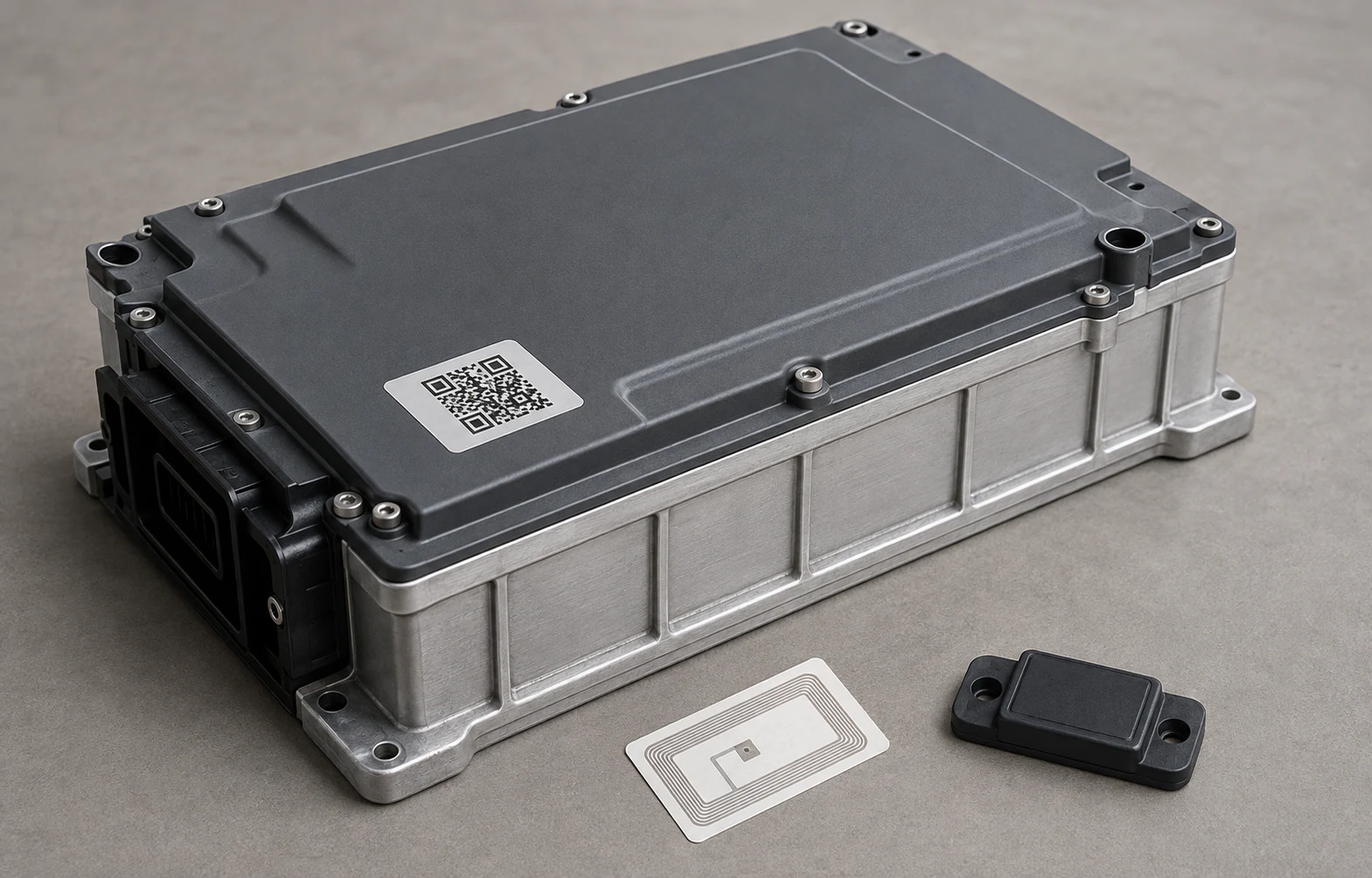
Two obligations begin on the same date, but they are not the same obligation. On 18 February 2027, every battery covered by Regulation (EU) 2023/1542 must be marked with a QR code. Only three groups need the electronic record defined as a battery passport: electric-vehicle batteries, light-means-of-transport batteries and industrial batteries with a capacity greater than 2 kWh.
The QR code on a starter (SLI) battery or portable consumer battery will not necessarily open a battery passport. For a battery outside Article 77, it must instead provide access to the applicable information listed in Article 13(6)(b) and, for SLI batteries, the additional information in Article 13(6)(c) when applicable. For a covered EV, LMT or large industrial battery, the QR code must lead through the battery’s unique identifier to its passport.
A sound project therefore has two workstreams. One assembles and governs the required data. The other puts the correct identity on the correct battery in a form that remains readable throughout the intended use. Treating the second workstream as a last-minute print job is an avoidable risk.
What changes on 18 February 2027?
Start by classifying the battery. The Regulation creates a broad QR-marking requirement and a narrower passport requirement.
All batteries in scope: a QR code
Article 13(6) requires all batteries within the Regulation’s scope to carry a QR code from 18 February 2027. For batteries without a passport, the QR code must provide access to the applicable Article 13(1)–(5) information, the EU declaration of conformity, the Article 52(3) report and the Article 74(1)(a)–(f) waste information. For SLI batteries, it must also provide the Article 8 recycled-content information when applicable.
EV batteries: an individual passport
Each electric-vehicle battery placed on the EU market or put into service must have its own electronic record. The passport combines model information with information specific to that battery and is reached through the required QR code.
LMT batteries: an individual passport
The requirement also covers each sealed traction battery weighing 25 kg or less that powers a wheeled vehicle by an electric motor, alone or together with human power, unless it is already classed as an EV battery. E-bikes and e-scooters are common examples, but the legal category is wider than either one.
Industrial batteries: watch the threshold
An industrial battery needs a passport when its capacity is greater than 2 kWh. The wording is strict: a battery rated exactly 2 kWh is not captured by this threshold, although it remains subject to the wider QR requirement and any other applicable duties.
The 71 data points: a guide to applicability, not a flat checklist
The European Commission’s Version 2.0 guidance, dated 15 August 2026, consolidates 71 numbered data points for EV, LMT and covered industrial batteries. Its value is the applicability matrix: each entry is marked mandatory, optional, conditional, repeated elsewhere or not required to be filled or displayed as of February 2027.
01–16 · Identity and basic characteristics
Unique identifier, responsible party, manufacturer, model or serial reference, manufacturing location and date, weight, capacity, chemistry, hazardous substances, extinguishing agent and critical raw materials. Even here, the Commission identifies repetitions and fields that are optional when the information is unavailable.
17–24 · Sustainability and sourcing
Carbon-footprint information, responsible sourcing, recycled shares and renewable content. Several entries depend on later implementing measures or application dates, so they should not all be presented as launch-day requirements.
25–44 · Performance, durability and compliance
Voltage, power, expected life, temperature range, efficiency, resistance, markings, conformity and information on use and waste prevention. Some fields apply differently to EV, LMT and industrial batteries or only when the parameter is relevant.
45–50 · Restricted technical information
Detailed composition, component and spare-part information, dismantling instructions, safety measures and test reports. These are not simply public consumer fields. Annex XIII restricts access by role, and, as at 3 September 2026, the Article 77(9) implementing act that will specify legitimate-interest access has not yet been adopted.
51–71 · Battery-specific lifecycle data
Dynamic values and history such as capacity and power fade, internal resistance, efficiency, state of health, state of charge, temperature history and status changes. The exact relevance and update method have to be resolved in the operational system, not left to the label artwork.
The Commission describes this document as implementation guidance. It introduces no additional legal requirement, is not an authoritative interpretation of the legislation and may be updated as formats and implementing measures develop.
Who is responsible for the battery passport?
The legal responsibility sits with the economic operator that places the finished battery on the market. Depending on the route to market, that party may be a manufacturer, importer or another operator. It is responsible for ensuring that the passport information is accurate, complete and up to date.
Another operator may be authorised in writing to act on its behalf. That makes specialist hosting, data, encoding and label partners possible, but supplying a QR or NFC tag does not make the converter the responsible economic operator. Responsibility, data ownership and technical delivery should be written into the project before identifiers are issued.
The passport also has a lifecycle. When a battery has undergone preparation for reuse, preparation for repurposing, repurposing or remanufacturing, the economic operator that places it on the market or puts it into service assumes the responsibility referred to in Article 77(4), and the battery must have a new passport linked to the original passport or passports. When the battery becomes waste, that responsibility transfers as set out in Article 77(7); the passport ceases to exist after recycling.
What the battery QR code must do
For a passport battery, Article 77 requires the QR code to provide access to the passport through a unique identifier attributed by the economic operator. The QR code and identifier must comply with the ISO/IEC 15459 series cited in the Regulation, or an equivalent. The law does not mandate GS1 Digital Link as the only route, although a company may choose a GS1 identification framework where it fits its system.
The physical marking matters. The Regulation requires the labels and QR code to be printed or engraved visibly, legibly and indelibly on the battery. Annex VI requires the QR code to contrast strongly with its background and be easily readable by a commonly available QR reader. Where this is not possible or not warranted on account of the battery’s nature and size, the labels and QR code must be affixed to the packaging and accompanying documents.
Those are performance outcomes, not a universal material specification. The Regulation does not prescribe one adhesive, face stock, protective laminate, IP rating or label size for every battery. The operator still has to turn the legal requirement into a construction that works on the actual housing and at the intended scan point.
Persistent identity
Define who issues the identifier, how it is kept unique, which record it resolves to and what happens when a battery, label or housing is replaced. The Registry does not create the identifier printed on the battery for you.
Reliable resolution
Test the complete path from a production identifier to the correct passport, including redirects, access rights, service continuity and failure handling. A QR that scans but reaches the wrong record is still a failed implementation.
Durable readability
Validate contrast, quiet zone, print or engraving quality, abrasion resistance, surface adhesion and camera access on the finished assembly. Artwork approval on a flat proof is not product qualification.
A compliant data model is of little use if the identifier cannot be read, and a perfectly printed code is of little use if it resolves to the wrong battery.
What the EU DPP Registry stores — and what it does not
The DPP Registry became operational on 20 July 2026. It is an EU-level indexing service that stores unique identifiers, registration data and high-level metadata. The detailed passport remains decentralised under the responsibility of the economic operator, either on its own infrastructure or with an authorised DPP service provider.
Before placing a passport product on the market, the relevant economic operator must register the DPP in accordance with the applicable legislation. The operator supplies the Unique Product Identifier; after successful registration, the Registry returns a separate Unique Registration Identifier. The two should not be confused in label specifications or system interfaces.
The Registry therefore does not remove the need for a product-data service, role-based access, long-term availability or data governance. Nor does it store the complete set of 71 battery data points as a central public database.
Where NFC and UHF RFID add value
The mandatory QR code is the regulatory entry point designed for commonly available readers; the information behind it remains subject to the applicable access rights. Additional carriers are a separate design decision. They make sense only when they solve a defined interaction or operating problem and resolve to the same controlled battery identity.
QR only
A durable QR label or direct mark may be sufficient when universal camera access is the main requirement and the operating process does not need tap-based service, cryptographic interaction or bulk radio reading. The engineering work is still real: identifier control, print quality, placement and lifetime readability all need validation.
QR + NFC
NFC can provide a deliberate phone tap for service, warranty, maintenance or a controlled handoff to the same passport. A normal NFC tag that stores a static URL adds convenience, not authentication. With a secure chip that supports dynamic authentication, controlled encoding and server-side verification, NFC can provide a per-tap cryptographic signal for the verification service to evaluate.
QR + UHF RFID
UHF RFID can support production, warehouse, fleet, repair and recycling workflows in which many batteries or assets must be identified without line-of-sight scanning. It requires compatible readers, process integration and a reliable identity mapping. It does not replace the phone-readable QR required by the current Regulation.
Why opening a URL is not the same as secure NFC verification
Engineer the carrier for the real battery
A battery label is exposed to a product, a process and an environment. Qualification should use representative finished assemblies, not only free-space inlays or laboratory print samples.
Metal and radio performance
Metal near an antenna can detune NFC and UHF RFID. Tag position, antenna design, spacer or ferrite construction and the final battery geometry have to be evaluated together. An on-metal catalogue label is a starting point, not proof of performance on every pack.
Surface and attachment
Powder coat, moulded polymer, texture, curvature, seams and contamination all affect adhesion. Define surface preparation, application pressure, cure time and the replacement policy before a production operator has to improvise them.
Temperature and chemicals
Manufacturing, transport, charging, service and cleaning can expose the carrier to temperature cycling, moisture, oils or chemicals. Test the proposed materials against the actual exposure profile; do not infer battery suitability from a generic label datasheet.
Read point and human access
A QR code needs a usable viewing angle, light and camera distance. NFC needs an intuitive tap area; UHF needs an engineered reader zone. Covers, brackets, vehicle installation and service access can change all three after the label has been approved.
Identity at production
Printing, encoding and application must be tied to the correct product record. Include verification after application, rejected-label controls, rework, duplicate prevention and evidence that the finished unit carries the intended identifier.
Removal, repair and replacement
Decide whether removal should destroy the carrier, leave evidence or be possible for authorised service. A damaged label, replaced enclosure or remanufactured battery needs a controlled identity process rather than an informal reprint.
A practical implementation sequence
The order matters. Data, identity and physical engineering should converge before serial production, not be reconciled after labels have been ordered.
- 01
Classify the battery
Confirm the legal category, capacity and route to market. Record whether the unit needs only the Article 13 QR information path or an individual battery passport.
- 02
Name the responsible economic operator
Define who places the finished battery on the EU market or puts it into service, who may act on its behalf and who owns decisions throughout preparation for reuse, preparation for repurposing, repurposing, remanufacturing and waste stages.
- 03
Map the 71 data points
Apply the Commission matrix to the relevant battery category and date. Assign a source, owner, access class, update rule and evidence trail to each applicable field.
- 04
Design the identity and resolution path
Select an issuing approach compatible with ISO/IEC 15459 or an equivalent, define the URL or resolver behaviour, and keep QR, optional NFC or UHF and backend records aligned.
- 05
Choose hosting and access controls
Separate public, authority and legitimate-interest information. Plan interoperability, persistence, backup, service exit and updates without assuming the EU Registry stores the full passport.
- 06
Engineer and qualify the carrier
Select direct marking, a flexible label or a rugged tag, then test it on the real housing for readability, attachment, radio performance where applicable and environmental exposure.
- 07
Control production assignment
Connect printing or encoding to the production record. Verify the finished battery, manage rejects and rework, and prevent identifiers from being duplicated or assigned to the wrong unit.
- 08
Pilot the full lifecycle
Test scanning, service, access rights, outages, damaged carriers, replacement, remanufacturing and end-of-life handoffs before committing the design to volume production.
Where ACCUZ® Industries and BrandGuard™ fit
The battery passport is a data-governance and compliance programme. ACCUZ and BrandGuard address the physical carrier, production identity and optional verification layers within that wider programme.
BrandGuard™ · Physical identity and secure NFC
Product-specific carrier design, controlled secure encoding, item-level identity binding and, where separately scoped, online verification before a handoff to the customer’s passport or service record.
RFID Label · Flexible and printable carriers
Standard and custom RFID or NFC labels, inlays, printed QR options and constructions for surfaces where a flexible carrier is appropriate, including projects that require an on-metal design.
RFID Tag · Rugged and on-metal formats
Hard, durable and on-metal RFID or NFC tag formats for battery packs, modules and installations where a conventional pressure-sensitive label may not be the right mechanical form.
RFID Solution · Readers and system integration
Readers, secure encoding, software and enterprise integration for production, inventory, service and lifecycle processes that use NFC or UHF RFID alongside the required QR code.
EU battery passport questions
Do all batteries need a battery passport in 2027?
No. From 18 February 2027, an individual battery passport is required for each EV battery, each LMT battery and each industrial battery with a capacity greater than 2 kWh that is placed on the EU market or put into service. Other battery categories are not brought into the full passport requirement by Article 77 merely because they need a QR code.
Do all batteries need a QR code from 18 February 2027?
Yes, for batteries within the scope of Regulation (EU) 2023/1542. For EV, LMT and covered industrial batteries, the QR code provides access to the battery passport. For other battery categories, it provides access to the information specified in Article 13 rather than a full passport.
Are all 71 battery passport data points mandatory at launch?
No. The Commission’s August 2026 guidance classifies fields by battery category and applicability. A field may be mandatory, optional, conditional, repeated elsewhere or not required to be filled or displayed as of February 2027. The guidance is a preparation aid and does not create new legal requirements.
Can NFC replace the battery passport QR code?
Not under the Batteries Regulation currently in force. The required access path is a QR code. NFC may be added for tap-based service, limited offline data or secure product verification, but it should complement the QR code and resolve to the same governed identity.
Does the EU require GS1 Digital Link for a battery passport?
The Regulation requires the QR code and unique identifier to comply with the cited ISO/IEC 15459 series or an equivalent. It does not name GS1 Digital Link as the only permitted implementation. GS1 may be a suitable issuing and resolution framework when selected and implemented consistently, but it is not the sole legal route.
Does the EU DPP Registry store the complete battery passport?
No. The Registry stores identifiers, registration data and high-level metadata. The detailed passport remains decentralised and is maintained by the responsible economic operator or an authorised service provider.
Who is responsible for the passport of an imported battery?
Responsibility follows the economic operator placing the finished battery on the EU market. The exact role depends on the supply arrangement, so importers and non-EU manufacturers should document who performs the obligation and any written authorisation rather than assuming the label supplier or DPP platform becomes responsible.
Primary sources and technical references
The legal requirements should be checked against the Regulation and current Commission material. Industry specifications are included only to explain optional carrier choices.
- Regulation (EU) 2023/1542 on batteries and waste batteries — consolidated text
- European Commission — Digital Product Passport for Batteries
- European Commission — August 2026 battery-passport guidance announcement
- European Commission — Digital Batteries Passport data points by category, Version 2.0
- European Commission — DPP Registry
- European Commission — DPP Registry User Guide for Economic Operators
- European Commission — Digital Product Passport implementation timeline
- CEN-CENELEC — European DPP standards
- NFC Forum — NFC Digital Product Passport Technical Specification
Reviewed against official material available on 3 September 2026. Commission guidance and Registry functions may change as implementation progresses. This article explains the published framework and does not constitute legal advice or a conformity assessment.