
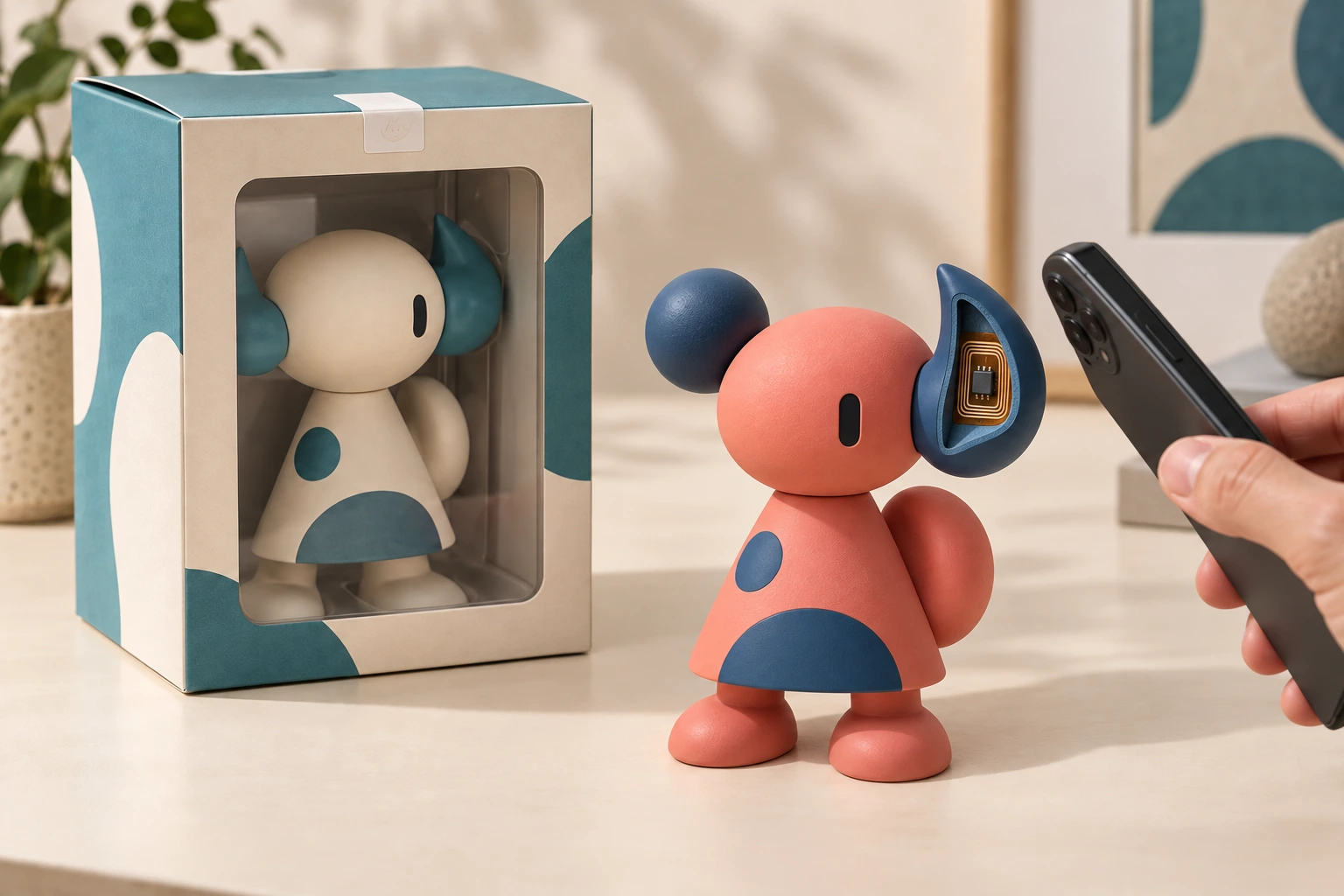
One collector keeps a limited edition figure in its original box. Another takes it out and gives it a place in a display cabinet. Either may eventually sell it to someone else. For the brand that released the figure, the same question follows both: can the next buyer find official information about the edition and the particular item in their hands?
If authentication is only available through the packaging, checking a figure becomes less convenient once it is on display. A brand can instead plan space for NFC inside the toy and embed the component during production. Collectors can then hold a phone near the designated position to start verification from the figure itself, with the component concealed within its design.
BrandGuard provides secure NFC and verification for both approaches: custom labels for a consistent box format, or embedded NFC components designed around the toy’s internal space and production conditions. Each component includes both a chip and an antenna. The following limited edition launch shows how a brand could use these options and what collectors would gain. It is an illustrative application, not a completed customer project.
Give collectors information they can compare with the figure
Imagine a designer releasing 300 figures in a blue colourway, with other colours to follow. The buyer receiving number 073 wants to know which blue edition it belongs to, whether the number matches and which accessories should be present. They also need to know that the information comes from the brand. A general product homepage cannot answer every question about that particular figure.
The packaging may matter to the collector too. For example, StockX's collectibles guidelines require Funko Pop figures sold through its marketplace to retain their original box and internal packaging. In that specific transaction, there is more to inspect than the figure alone; it does not mean that all designer toys must remain sealed.
The brand therefore needs to decide what it wants to identify: a packaged unit, or a figure intended to be displayed outside its box. Photographs, colourway, dimensions, release details and an individual item number then give collectors something concrete to compare with it.
For a consistent box format, design the label into the packaging
When a collection uses the same box format, the label size and position can be planned alongside it. Funko's own standard Pop! protector illustrates this: it fits a standard-size Pop! box. That does not make the same format suitable for every oversized figure or multipack.
For a brand with repeatable packaging, BrandGuard can design an NFC label for the box face, a designated label area or the closure. Different characters can retain their individual artwork while using an agreed label specification. Before dispatch, each tag is associated with its own item record, so the collector can consult details of that unit rather than only a generic promotional image.
If the project also needs to show whether a seal has been opened, a tamper-detecting NFC label can bridge the opening being protected. Before opening the box, the collector can check the current tag verification result and the seal state separately. That state concerns the designed seal position; other parts of the packaging still need inspection.
A reusable protective case needs a different assessment. Adding a tag to a case that can be opened does not, by itself, establish a reliable link with whatever is inside. Packing, item association and sealing need to be part of the brand's dispatch process. Funko and StockX are independent industry references here, not examples of BrandGuard customers.
Embedded NFC makes verification part of the product
For a toy that collectors often display outside its box, NFC can be built into the product itself. For example, a designer could leave space inside the figure’s ear for a component to be embedded during production. A collector would then hold a phone near that position to start verification. A foot or another part could also work, depending on the character’s shape, internal structure and intended use.
The brand can begin with its product requirements and leave the antenna design, material selection and manufacturing choices to BrandGuard. We develop the NFC component around the toy’s structure and production conditions. Four pieces of information provide a useful starting point.
First, specify the available space: the length, width and thickness available for the complete NFC component, including its chip, antenna and encapsulation. If the space has an unusual shape, a drawing or sample helps us plan how the component will fit.
Second, tell us the highest temperature the NFC component must withstand during production. When will it be incorporated into the toy, and what temperatures will it experience in that process? These conditions guide the choice of materials and manufacturing process.
Third, explain your material requirements. Tell us your preferences for the NFC component or its encapsulation, as well as the materials surrounding it inside the toy. This helps us select materials that suit production and work with the finished design.
Fourth, describe the target reading distance. Where should collectors hold their phone, and how far from the finished surface should they be able to read the tag? This intended use helps guide the antenna design and placement. We then test samples in the actual product structure with phones to confirm the reading performance.
With these four requirements, BrandGuard can design the component, make samples and check its performance with the brand after embedding. Planning NFC during product development lets verification stay with the figure: collectors can still consult its edition and individual item details after unboxing it for display.
The embedded location must also suit what is being identified. A freely interchangeable accessory could be moved to another figure while its NFC component still returns the original details. When the aim is to identify the figure itself, consider how that part connects to it. Brands can also use a packaging seal alongside embedded NFC, supporting package checks before opening and collectible checks afterwards, with the relationship between their records defined for the project.
How a tap takes the collector to the brand's verification result
With NFC concealed inside the toy, collectors need to know where to hold their phone. Mark the reading position on the packaging instructions or an accompanying card. The collector holds an NFC-enabled phone near that position, then opens the link offered by the phone. A packaging label needs equally clear guidance about where to read it.
Opening the link first connects the browser to BrandGuard’s verification server, which checks the information from this read. If the brand chooses to display results on its own website, successful verification redirects the browser to the configured product page. The official BrandGuard component on that page then displays this result. BrandGuard provides the component and the verification interface it uses; WordPress sites can use the plugin. The brand website verification guide explains the integration. Brands can also choose a verification and product information page created and hosted by BrandGuard.
For this example, the brand could supply photographs of the blue figure, its series, dimensions, edition size, individual number 073 and expected accessories. A green figure, a different number or missing accessories would give the buyer a specific discrepancy to raise with the seller or brand. The brand supplies and maintains these details. NFC does not independently judge the sculpture, paintwork or artistic origin.
The tag verification result tells the collector whether this read passed the check. The photographs, number and other product details help them compare the object in their hands with the brand’s record. Where a tamper-detecting tag is used, its seal state is shown separately. Opening a box for display is normal use, so an opened seal alone does not make a figure counterfeit.
At a later sale, the next buyer can read the NFC component in the physical item again. An old screenshot, an old link or a page refresh does not establish a new valid verification. Buyers gain access to official information, but the process does not automatically assess condition, set a resale price or register a change of ownership.
- Read the secure NFC tagHold a phone near the embedded NFC component in the figure or the tag on its packaging.
- BrandGuard checks this readThe verification server checks the information from this tap.
- View the official result on the brand pageAfter successful verification, the browser redirects and the official component shows this result.
The tag must first be linked to the item record and the brand page must be configured for integration. This is a process diagram, not a live verification result.
Where NFTs can fit into a physical toy collection
The same collection could offer a digital experience. Suppose the brand commissions digital artworks to accompany the 300 figures. After checking their physical collectible, an owner may want to see which digital work relates to it, whether they are eligible to claim it and where to do so. An NFT is a digital token recorded on a blockchain, which a project can associate with digital artwork or specified benefits.
As part of a planned project, the relevant information page can include the brand's NFT explanation or a link to its chosen platform. BrandGuard supplies physical tag verification and information pages. The brand and the selected platform must arrange NFT issuance, wallet connections, eligibility and transfer processes. Adding NFC does not automatically mint an NFT, and an ordinary online product record is not itself an NFT.
Resale needs particular care. If the collector sells figure 073 but keeps its associated NFT, the physical and digital collectibles may belong to different people. The brand should explain what a subsequent buyer receives, whether the NFT must be transferred separately and what happens to benefits that have already been claimed. Reading the tag does not complete those handover steps.
A buyer who only wants to check the edition and item number should be able to use the verification page without setting up a wallet. For collectors who wish to take part, an NFT can offer a way to explore and collect associated digital artwork. The brand should describe the actual work and benefits available, without promising future appreciation.
Start with one collection and test the whole experience
Start with one upcoming collection. Bring a drawing or sample of the figure to discuss packaging labels, embedded NFC or a combination of both with BrandGuard. For an embedded solution, provide the four design requirements: available dimensions, maximum production temperature, material requirements and target reading distance. Agree which product information collectors will see alongside the result. The custom NFC security label guide covers packaging label appearance and physical protection in more detail.
Before release, ask people who were not involved in the project to try it. Can they find the reading position, read the tag with a phone and compare the information on the page with the figure? Can they contact the brand if the details do not match? If the collection includes an NFT, check the claim and resale processes separately so that collectors understand what to do next.
For the brand, this keeps official product information useful through unboxing, display and later resale. Collectors can compare editions, item numbers and accessories with the brand’s record, while the support team can discuss the particular collectible in question. Verification becomes a service collectors can return to whenever they need to check the details.
Frequently asked questions
What does BrandGuard need to design NFC into a collectible toy?
Provide the dimensions available for the complete NFC component, the highest temperature it must withstand during production, material requirements and the desired reading distance. BrandGuard can design the antenna, select materials and a manufacturing process, and test samples to confirm performance after embedding.
Can collectors verify a figure after removing it from the box?
With NFC embedded in the figure itself, collectors can hold a phone near the designated position after unboxing to access verification and the associated product information. A packaging seal reports on the packaging instead. These checks serve different purposes; normal opening alone does not make a figure counterfeit.
Does an NFC tag automatically link and transfer a toy and its NFT?
NFC can provide physical tag verification and access to information or a project platform. NFT issuance, claiming and transfers need separate planning and integration. Handing the figure to a new buyer does not automatically transfer the NFT; the brand needs clear rules for both the physical item and digital benefits.
Plan authentication around your toy collection
Tell us where NFC should sit inside your toy, the available dimensions, the highest production temperature, your material requirements and the target reading distance. BrandGuard can design the antenna and select materials and a manufacturing process, alongside planning the item information and verification page.
Discuss collectible toy authentication →