
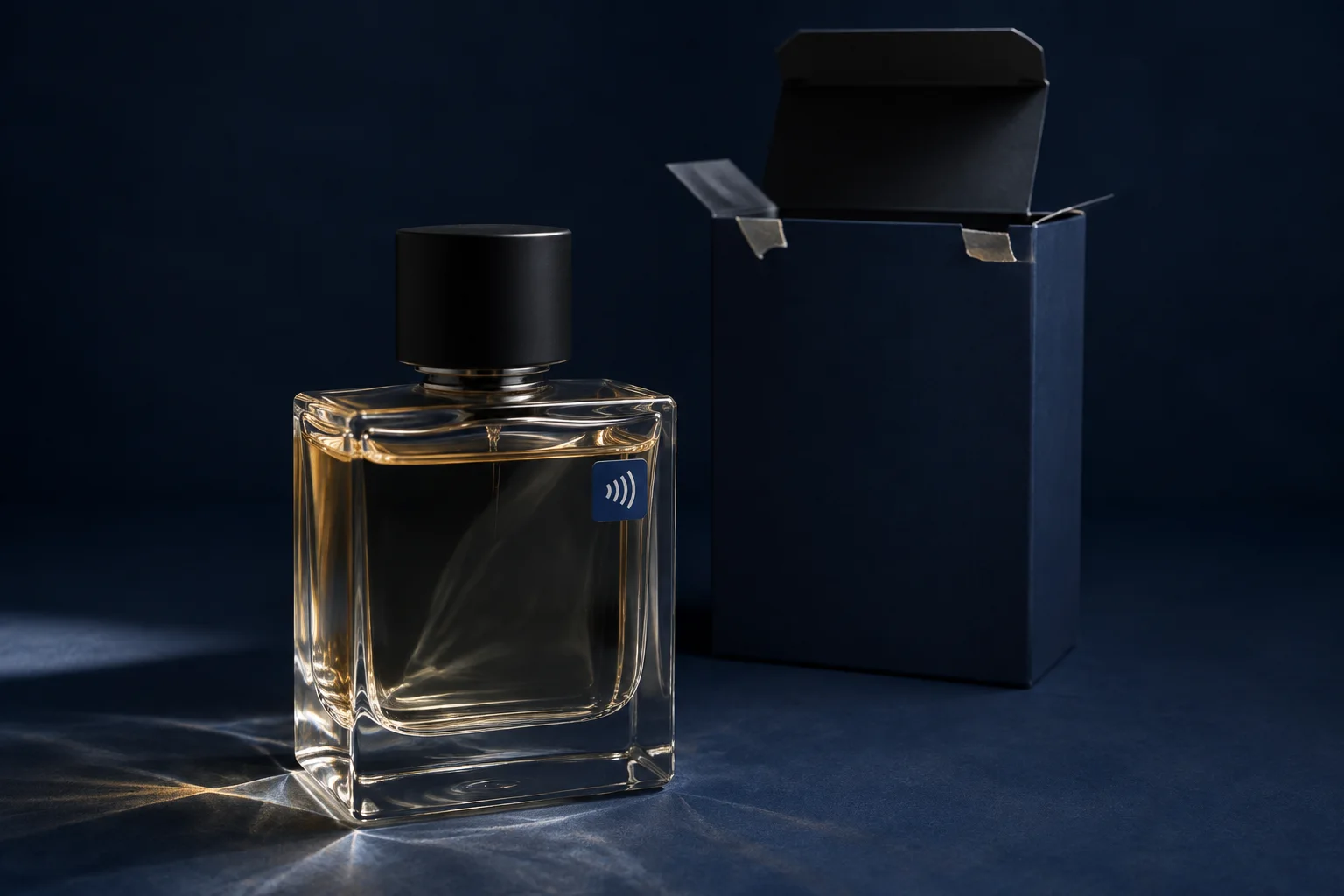
Once a perfume reaches a customer through a distributor, retailer or marketplace, how can its manufacturer help them check its identity? And when that customer needs product advice, a refill or support, can the bottle take them straight to the brand? Perfume brands and manufacturers have a reason to consider both questions when developing their packaging.
BrandGuard can design secure NFC tags for perfume packaging and provide an online verification service. Customers hold a compatible phone near the tag to see the verification result and the relevant official product information. The same page can lead to refills, support and brand content. Deciding what customers should be able to do helps determine whether the NFC belongs on the carton, the bottle or both.
Give customers a useful way to check their perfume
When a customer asks whether a perfume is genuine, the brand needs a check it can explain. A batch code can help identify production information, but it does not settle the question on its own. CheckFresh describes its service as a production-date lookup; finding a plausible date does not authenticate the bottle in front of the customer.
BrandGuard can prepare secure NFC tags and connect them to the correct perfume details before dispatch. A customer taps the tag, the online service checks it, and the page displays the registered product information. The customer can compare the fragrance name and size with the bottle in hand. The service checks the secure tag as well as displaying the product page.
There are examples in the industry already. Xerjoff says it began using Certilogo-powered NFC tags in March 2025 for authentication and brand content. For a perfume manufacturer considering NFC, this shows an application in actual packaging, beyond a promotional demonstration.
Keep the connection on the bottle, after the box is gone
With NFC on the bottle, customers do not have to search for the fragrance again or keep the instruction card. When they want advice or information, a tap can take them back to the brand's page. That access remains with the product even when the carton has been discarded.
Show a clear verification result first, followed by content relevant to that perfume. Fragrance notes and the perfumer's story can help customers learn about it. Storage advice, support and the right official refill give them a practical reason to return.
The page can also carry sampling invitations, membership offers or social-sharing options. Participation should be a choice, not a requirement for basic verification. These activities need content and a team to run them; adding an NFC tag does not create a customer programme on its own.
A bottle may still be in use months after a campaign ends. Promotions can change, but information about the original perfume, refill links and support should remain available. Agreeing who maintains those pages is part of planning a useful service.
Show an opening alert without losing access to the product
For a manufacturer that wants customers to check a newly purchased carton, an NFC seal can sit across the opening. BrandGuard's tamper-detecting NFC closure seal uses NTAG 424 DNA TT and can work with the verification page to report detected opening.
Opening the box does not necessarily stop the seal from working. If the part of the tag needed for reading remains undamaged, customers can still see the brand and product information, along with any detected opening alert.
Someone who has just received a product sold as unopened can use that alert as a reason to check with the seller or brand. If they opened the box themselves, the same alert is expected. An opened seal should not automatically be described as a counterfeit product.
The seal must suit the carton. If the top is sealed but the bottle can be taken out through the base, the design needs attention. The tag checks its status when read, rather than monitoring continuously, and cannot reveal every interference attempt. Development should therefore consider removal and reapplication, other ways into the box and accidental damage in normal transport.
Make the filled bottle easy to read
Bottle NFC suits brands that want authentication and customer services to last beyond unboxing. But perfume is a liquid, and glass thickness, curves and decoration vary. A general-purpose NFC label may not read well simply because it has been attached to the bottle.
BrandGuard can use NTAG 424 DNA with an on-liquid NFC antenna designed for a filled bottle. In practical terms, the tag is developed around the perfume and its packaging, rather than assuming one standard label will work on every bottle.
Development uses filled, fully decorated samples to choose a position and check reading with different phones. If access should last until the perfume is nearly finished, check full and partly used bottles too. The placement should respect the packaging design while making it clear where customers should hold their phones.
Attachment matters as well. The tag needs to withstand everyday use and should be difficult to remove intact and put on another bottle. BrandGuard can consider these requirements alongside the antenna and tag format. Materials and fixing methods depend on the actual bottle.
Match the tag to the right perfume before dispatch
A tag on a 50 mL bottle should show the details for that 50 mL fragrance. BrandGuard can provide secure tag encoding and support the agreed product-registration process, so the tag on the packaging leads to the correct information.
If carton and bottle both carry NFC, their records can refer to the same product while serving different purposes. The carton reports seal status; the bottle keeps product checks and services available. Customers need a consistent experience, not two unrelated pages.
Before production, the brand, factory and BrandGuard should agree who supplies product details, where tags are applied and checked, and how faulty labels, replacement cartons or rework will be handled. For contract manufacturing, the brand's responsibilities should be clear too.
Give customers a result they can understand
The verification page is part of the brand's service. Customers need to know what was checked, whether anything needs attention and who can help. A red failure message alone is not enough, and difficulty reading a tag should not be labelled as proof of a fake.
The examples below show information a brand can plan for its page. Opening status is available only with a seal designed to detect it, not with an ordinary bottle tag.
| What happens | What the page should explain | Useful help |
|---|---|---|
| Verification succeeds | Show the corresponding fragrance name, size and other agreed details. | Product information, care advice or support. |
| The seal reports a detected opening | Explain the seal result without automatically calling the product counterfeit. | Contact the seller or brand if it was bought as unopened. |
| Verification is unsuccessful | Say that the check has not produced a valid result, without guessing why. | Try another tap or contact the brand. |
| The tag cannot be read or the service cannot be reached | Explain that the check cannot yet be completed. | Show where to hold the phone or suggest trying again later. |
Help customers find the right refill
For a refillable fragrance, bottle NFC can lead directly to the matching official refill and instructions. Customers do not have to work through similar names and different sizes, and the brand gains another opportunity to provide a useful service.
Opening a refillable bottle is normal use. Mugler's official instructions include removing and replacing the pump. NFC retained on the bottle can continue to offer product checks and refill information after refilling.
Keep one distinction clear: a tag check is not a test of the liquid. A genuine tag on the original bottle does not establish where a later refill came from. If the brand wants to record an official refill, the brand or an authorised service point needs to confirm it; a customer tap alone does not do so.
Where BrandGuard can help
A manufacturer with its own verification platform can choose physical NFC design and manufacturing or secure encoding. Brands looking to develop the NFC packaging and online verification together can discuss a complete solution with BrandGuard online verification. The scope can fit what the customer already has.
A carton project starts with the box and its openings; a bottle project starts with a filled sample. Other formats, such as incorporating NFC into a closure, can be assessed as custom requirements. Two tags are not necessary for every perfume: the carton addresses opening checks, while the bottle keeps access available during use.
A small trial with one product can show how the experience works in practice. Can customers read the tag easily? Do they understand the messages? Do they use the refill or support links? These questions are more useful than a total scan count.
Include prototype development, tags, production work, the online service and content upkeep together. Reviewing the physical sample, phone experience and full cost gives the manufacturer a basis for deciding where to start and whether to expand. For other options, see the guide to anti-counterfeit label types and selection.
Practical questions
Can a perfume batch code prove authenticity?
Not on its own. It can help identify a production batch or date, but a plausible lookup result does not authenticate the bottle in front of the customer.
Can the NFC seal still be read after the box is opened?
It can be designed to remain readable. If the part of the BrandGuard TT seal needed for reading is undamaged, customers can still see brand and product details along with detected opening alerts. It cannot reveal every interference attempt.
Will perfume inside the bottle make NFC difficult to read?
Liquid and the bottle can affect reading, so a demonstration with a loose tag is not enough. BrandGuard can design an on-liquid NFC tag for the filled bottle, then use actual samples and phones to check placement and performance.
Does a successful bottle check mean a later refill is genuine?
No. Tag verification is not a liquid test. The refill's source needs separate confirmation. Bottle NFC can help customers find official refills, but cannot guarantee what has subsequently been put inside.
Sources and technical references
- CheckFresh — purpose of batch-code lookup
- Xerjoff — NFC authentication announcement
- NXP AN12196 — Secure Dynamic Messaging and TagTamper, especially §6.5
- NXP NTAG 424 DNA — data sheet
- NXP NTAG 424 DNA TT — data sheet
- ST AN2866 — antenna design and final-application tuning, §§5–6
- Mugler — official home-refill instructions
Sources checked on 6 September 2026. The brands cited are public examples, not BrandGuard customer case studies.