
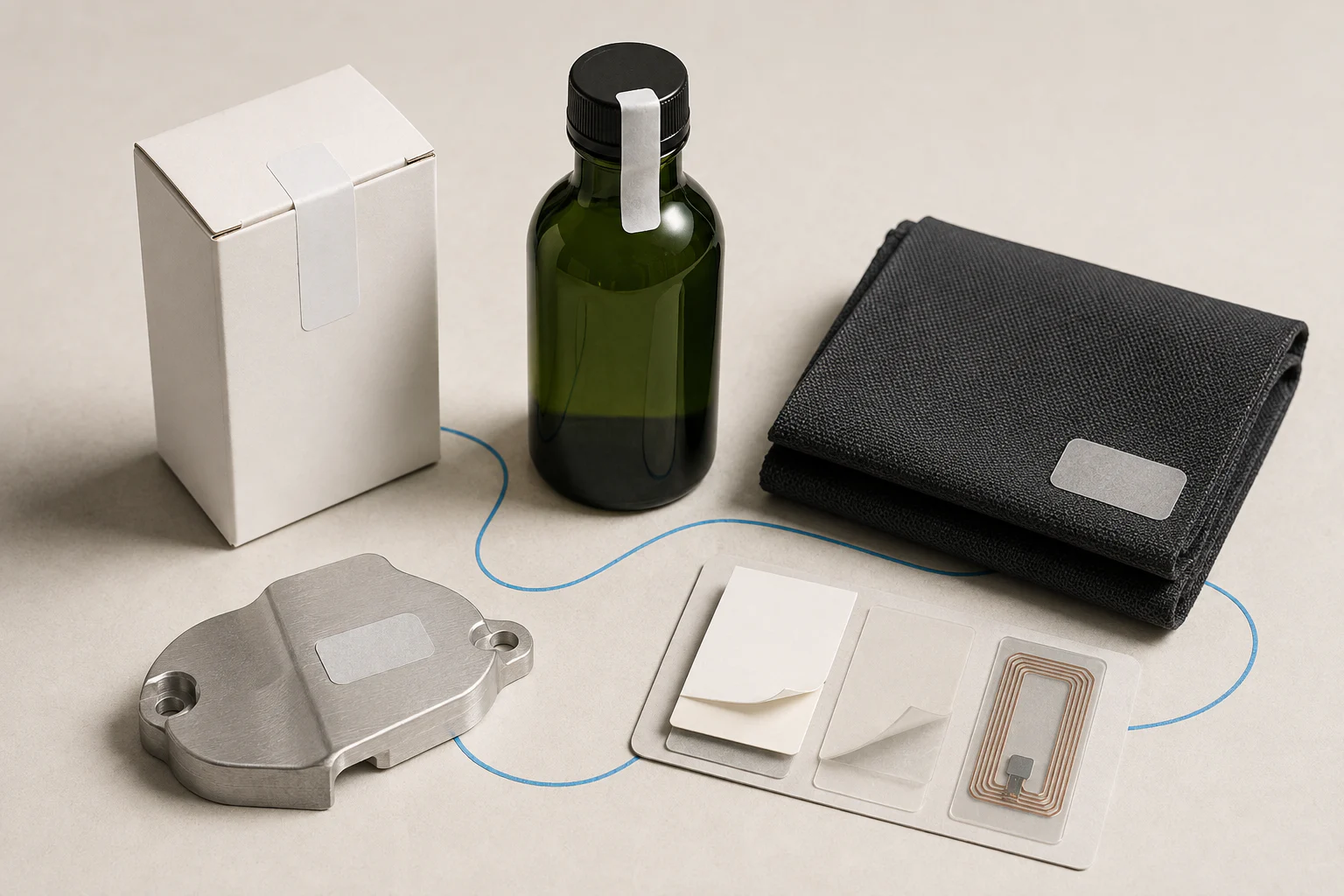
An anti-counterfeit label is a label or product-attached device designed to support authenticity checks and make fraud more difficult or detectable. That broad definition covers everything from a printed hologram to a cryptographic NFC seal. The technologies are not interchangeable, and the most expensive option is not automatically the right one.
A buyer usually arrives with a product problem, not a technology brief: fake refills are appearing in genuine bottles; warranty returns contain substituted parts; a serialised QR is being copied; or authentic labels are being removed and sold with counterfeits. Each failure calls for a different combination of identity, physical construction and verification.
This guide compares the principal types of anti-counterfeit labels, explains what suppliers often call security levels, and sets out the questions to resolve before requesting samples or a quotation. It treats the label as one part of a protection system rather than as a decorative security feature.
Anti-counterfeit, tamper-evident and track-and-trace are not synonyms
A clear specification begins by separating three jobs that are often bundled under the word ‘security’. One construction can support more than one job, but the evidence should not be overstated.
Anti-counterfeit and authentication
The aim is to distinguish a product, label or data record that comes from an authorised source from one that does not. The design must state what is being authenticated. Obtaining a valid cryptographic response from a tag, for example, is not automatically proof that the product carrying it is genuine.
Tamper evidence
A destructible face stock, VOID pattern, closure seal or electronic tamper loop can reveal removal or opening. It provides evidence of an event; it does not promise that opening is impossible, and it does not establish provenance on its own.
Serialization and track-and-trace
A unique code identifies one item and can support manufacturing records, distribution events, recalls and duplicate-scan analysis. A serial number is still data that can be copied. Its value depends on controlled issuance, the records behind it and how exceptions are handled.
Seven technologies used in anti-counterfeit labels
ISO 22383 categorises authentication elements as overt, covert and forensic. Commercial labels also combine these features with tamper evidence and digital carriers. The categories below describe functions, not a league table.
1. Overt visual features
Holograms, optically variable effects, colour-shifting inks and finely registered print can be checked without a tool. They are useful for instant recognition and deterrence, especially when customers know what to look for. A convincing imitation may still fool an untrained buyer, so the feature needs controlled artwork, sourcing and public education.
2. Covert features
UV-fluorescent inks, microtext, hidden images and covert machine-readable taggants require a specified light, lens or reader. They give inspectors a second test that is less obvious to copy. The organisation must control the detector, reference sample, training and escalation process; a secret feature that nobody checks adds little protection.
3. Forensic features
Laboratory-confirmed markers can support high-confidence investigations and disputes. They are deliberately harder to reproduce but slower and more specialised to verify. Forensic evidence normally complements, rather than replaces, a fast field check.
4. Tamper-evident constructions
Destructible papers and films, delaminating structures, VOID residues, frangible cuts and closure-crossing seals make removal or opening visible. The construction must match the substrate and opening path. A label that fractures beautifully on glass may lift intact from a textured, low-energy plastic.
5. Serialized QR and barcodes
A unique QR code is inexpensive to scan and can connect an item to product data, warranty or a verification service. The printed image can be photographed and reproduced. Server-side duplicate, location and sequence checks may expose abuse, but a clean first scan of a copied code is not conclusive proof of authenticity.
6. Conventional NFC and RFID
NFC gives customers a deliberate tap interaction; UHF RFID supports longer-range, non-line-of-sight operational reading. NDEF is a data format, not an authentication mechanism. A static URL, unsigned NDEF payload or basic identifier can be copied. Additional controls can authenticate the data or detect reuse, but they do not make the transmitted data uncopyable. Chip capabilities, configuration, access control and the verifying system determine what evidence is available.
7. Secure cryptographic NFC
A suitable chip can generate a cryptographic response that the verification service checks using protected keys. With NXP NTAG 424 DNA, for example, dynamic data can include chip identity, a read counter and a message authentication code. A defensible deployment also requires correct configuration and encoding, a deliberate per-tag key strategy, protected key management, verifier checks and replay handling.
Choose against the attack, not the catalogue name
Before comparing label samples, write down how fraud would work on this product. Five attack paths account for many real-world failures.
Copy or look-alike
The counterfeiter reproduces the visible artwork, holographic appearance or printed code. Use controlled, difficult-to-reproduce features and a verification route that does more than compare appearance.
Clone or emulate
Static digital content or a basic identifier is copied to another carrier or emulated. Cryptographic challenge or dynamic proof raises the technical barrier, provided the verifier actually validates it.
Transfer, refill or substitution
A genuine label, seal, closure or package is reused with a fake product. Destructible materials, closure-spanning antennas, cable seals or product-integrated badges help bind identity to the physical item and expected opening event.
Replay
A previously valid digital message is captured and presented again. In an NTAG 424 DNA SDM/SUN deployment that claims replay detection, the verifier must track the read counter for each tag and reject values already seen or received out of order, then assess the wider scan context. The chip does not provide a trusted timestamp, and counter checks mitigate rather than eliminate replay risk.
False verifier or compromised records
A copied code sends the buyer to a convincing fake page, or an authorised identifier is associated with the wrong item. Trusted domains, controlled resolution, protected records, access control and monitoring matter as much as the carrier.
A practical five-layer protection framework
These are BrandGuard selection layers, not ISO grades or product certifications. A project may use only the layers justified by its risk. Higher risk usually calls for several independent forms of evidence rather than a single premium-looking feature.
- 01
Recognition and deterrence
Create an overt feature that staff and customers can recognise, then control the master artwork and approved production route. Its purpose is rapid screening and deterrence, not final proof.
- 02
Evidence of opening or transfer
Engineer the label, seal, antenna and attachment around the real surface and opening path. The desired result may be visible destruction, a persistent residue, a broken conductor or a changed electronic tamper state.
- 03
Controlled item identity
Issue one governed identifier per item, prevent accidental duplicates and connect it to the correct production record. Decide who may encode, rework, replace or retire an identity.
- 04
Cryptographic verification
Use a suitable secure chip or signed-data method when the threat warrants it. Protect keys, configure each item correctly and verify the evidence on a trusted service. Opening a URL is an interaction; a valid cryptographic check authenticates the tag credential or signed data named by the design, not automatically the physical product.
- 05
Operational detection and response
Monitor counters, repeated scans, impossible travel, unusual volumes and status changes. Define the message shown to a customer, the evidence retained for investigators and the action taken when a result is suspicious.
Quick comparison: what each option is good at
Use this as a first screen, then qualify the proposed construction on finished products. ‘Best for’ describes a useful role, not a guarantee of authenticity.
| Label or feature | Useful for | Main limitation |
|---|---|---|
| Hologram or overt print | Fast visual screening and deterrence | Appearance can be imitated; users need a known reference |
| Covert or forensic marker | Inspector checks and investigations | Needs a tool, controlled reference or laboratory |
| Tamper-evident label | Showing removal, opening or transfer | Does not prove authorised origin by itself |
| Serialized QR code | Low-friction item lookup and scan analytics | Printed code can be copied and shared |
| Conventional NFC / RFID | Tap experiences or operational identification | Static data is not cryptographic product authentication |
| Secure cryptographic NFC | Per-read evidence when correctly configured and validated | Needs secure encoding, keys, a verifier and physical binding |
How to choose an anti-counterfeit label
A useful request for quotation describes the product and the verification process, not just the preferred chip or material. These six decisions have the greatest effect on construction, cost, minimum order quantity and lead time.
1. Who will verify it?
A consumer with a phone, a distributor with a handheld, a factory with fixed RFID readers and a laboratory have different needs. Specify the reader, connectivity, time available and result the operator must understand.
2. What fraud matters most?
Rank imitation, copying, transfer, refill, diverted genuine goods, unauthorised production and false warranty claims. A label optimised for one attack can leave another untouched.
3. Where will it be attached?
Provide the substrate, coating, texture, curvature, available footprint, seam and opening direction. Metal and liquids affect radio performance; low-surface-energy plastics, dust, oils and plasticisers affect adhesion.
4. What must it survive?
State application temperature, service temperature, moisture, UV, abrasion, chemicals, washing, flexing and intended life. ‘Permanent adhesive’ is not a test result. Use representative aged products, not only clean laboratory coupons.
5. What evidence and data are needed?
Decide whether the verifier needs a visible check, an opening state, a unique identity, cryptographic proof, supply-chain events or several of these. Define the system of record and privacy limits before artwork is released.
6. How will it be made and controlled?
Volume, number of artwork versions, personalisation, encoding, inspection, roll format, application equipment and reject handling all affect price and MOQ. Ask how over-runs, waste, keys and unused serials are accounted for.
Match the physical format to the product
BrandGuard uses secure NFC in several constructions because cartons, bottles, garments and reusable assets face different failure modes. Choose the physical format around how the identity must remain bound to the product.
Destructible secure NFC label
For cartons and flat product surfaces where a compact label should support smartphone verification and resist clean removal. Shape, print, hologram, QR and serialisation can be designed around the application.
Tamper-detecting closure seal
For bottles, jars and packs, a dedicated tamper loop or detection conductor crosses the opening path while the RF antenna remains readable. With NTAG 424 DNA TagTamper and a correctly engineered construction, the verification service can assess cryptographic evidence and the electronic tamper state on a later read.
Product-bound cable seal
For items or containers that offer an eyelet, handle or locking point. A single-use cable creates a mechanical relationship between the NFC identity and the secured object.
Heat-applied NFC badge
For garments and technical textiles where a pressure-sensitive label is unsuitable. The stack must be qualified for the fabric, heat-press process, flexing and required wash conditions.
Durable surface-mounted NFC tag
For equipment, tools, artwork and reusable assets that need a longer-lived construction. Housing, adhesive and radio performance are selected for the mounting surface and service environment.
What advanced anti-counterfeit protection looks like in practice
A stronger system does not depend on one ‘unclonable’ label. It combines evidence that is useful against the product’s actual threats: item-level identity, signs of opening or transfer, cryptographic verification and controlled records. Those controls raise the cost of fraud and improve the chance of detection; they do not make counterfeiting impossible.
In a secure NFC deployment, each chip is configured and encoded under a controlled profile. On a tap, a verification service checks the cryptographic response and relevant dynamic values. It also checks the business context: whether the item exists, whether it was released, whether a tamper state has changed where the chip and construction support it, and whether the scan pattern is plausible. The customer sees a clear result rather than raw chip data.
The physical design closes a gap that digital projects often miss. If a perfectly valid label can be peeled from a genuine carton and placed on a counterfeit, the system may authenticate the label while misleading the buyer about the product. Destructible layers, antennas or sensing conductors that cross the closure, single-use seals and product-integrated badges can make that transfer visible or impractical for the intended use case.
Physical protection
A product-specific label, seal, badge or durable tag, qualified on the actual substrate and opening path.
Secure encoding
Controlled chip configuration, item-level identity, protected keys and verified production records.
Live verification
A trusted service that checks cryptographic evidence, state and scan context, then records actionable events.
The label carries evidence. The system decides whether that evidence is valid, belongs to the expected item and is credible in context.
Read why opening a web page is not the same as secure NFC verification
Five mistakes that weaken a security-label project
Most failures are not caused by the absence of a fashionable feature. They come from an incomplete specification or an untested handoff between the label, the product and the verifier.
Treating a QR code as proof
A QR code can carry a unique identifier, signed data or a trusted link, but the printed symbol itself is copyable. State exactly what the service checks after the scan.
Calling every NFC tag secure
A static web link on a basic NFC tag may be useful, but it is not the same as a cryptographic response validated by a trusted backend.
Testing the inlay, not the product
A datasheet result does not cover your bottle coating, metal housing, textile finish, curved corner, application pressure or ageing profile.
Ignoring label transfer
Authentication of the carrier is not enough when the carrier can be moved intact. Define the physical bond and what a verifier should conclude after opening.
Launching without an exception process
Suspicious, repeated, damaged and offline scans need agreed messages, logs and owners. A red screen with no investigation route creates support traffic, not protection.
What to test before mass production
A representative pilot should prove the construction and the operating process together. Keep approved samples and acceptance criteria so that production lots can be compared with the design that passed.
- 01
Map the threat and verification journey
Document the likely attacker, verifier, reader, scan location, network conditions, expected result and escalation path.
- 02
Build on production-representative surfaces
Apply samples to real substrates using the intended equipment, preparation, pressure and cure time. Include seams, curves, metal and liquid proximity where relevant.
- 03
Age and attack the samples
Test removal and transfer as well as temperature, humidity, abrasion, chemicals, flexing or washing. Record what counts as a clear tamper result.
- 04
Verify data and radio behaviour
Check every unique identity, encoding profile, QR readability and NFC or RFID read performance. Include duplicates, damaged items, replay attempts and backend outages.
- 05
Audit the production controls
Reconcile issued identities, good units, rejects, rework, over-runs and destroyed waste. Confirm who can access artwork, keys and verification records.
Anti-counterfeit label FAQ
What is the difference between an anti-counterfeit label and a tamper-evident label?
An anti-counterfeit solution supports a judgment about authorised origin or authenticity. A tamper-evident label shows that removal, opening or transfer may have occurred. One label can do both jobs, but tamper evidence alone does not prove who made the product.
Which type of anti-counterfeit label is best for my product?
There is no universal best type. Start with the most damaging fraud scenario, who will verify the item, the product surface and opening path, the service environment, production volume and the evidence needed. Low-risk goods may use controlled overt features and serialization; higher-risk products may justify tamper-evident construction, cryptographic verification and monitoring together.
Can a QR code alone prove that a product is genuine?
No conclusion should be based only on seeing or scanning the printed symbol, because it can be copied. A QR code can participate in a stronger system by carrying a unique identifier or signed data and connecting to a trusted verification service. The service and physical product binding determine what the scan can prove.
When is secure NFC worth using instead of a serialized QR code or hologram?
Secure NFC is worth considering when copied codes, convincing visual imitations or repeated high-value fraud create enough risk to justify machine-verifiable cryptographic evidence. It is most useful when phones are part of the verification journey and the project can support secure encoding, key management, server validation and a suitable physical attachment.
How do you stop a genuine label being transferred to a counterfeit?
Design the attachment to fail or change when removed: destructible stock, delaminating layers, a seal over the opening, a breakable antenna or a single-use mechanical fixing. Then test the construction on the actual product after ageing. No design should be called transfer-proof without evidence from the intended application.
What affects custom anti-counterfeit label cost, MOQ and lead time?
The main factors are materials, adhesives, dimensions, artwork versions, overt or covert print features, chip and antenna, variable printing, secure encoding, inspection, roll format, tooling, sample tests and total volume. A supplier needs the application and data requirements before a meaningful quotation can be prepared.
Standards and technical references
The sources below define selection principles and the capabilities or limits of digital carriers. Product qualification still has to be performed for the intended application.
- ISO 22383:2020 — Security and resilience — Guidelines for the selection and performance evaluation of authentication solutions for material goods
- ISO 22378:2022 — Security and resilience — Interoperable object identification and related authentication systems to deter counterfeiting and illicit trade — Guidelines
- ISO/IEC 20248:2022 — Automatic identification and data capture techniques — Digital signature data structure schema
- GS1 Digital Signatures Technical Implementation Guideline, Release 1.1.0
- EUIPO Anti-Counterfeiting and Anti-Piracy Technology Guide
- NFC Forum — NFC Data Exchange Format (NDEF)
- NFC Forum — Signature Record Type Definition
- NXP AN12196 — NTAG 424 DNA and NTAG 424 DNA TagTamper features and hints
- NXP NTAG 424 DNA data sheet
- NXP NTAG 424 DNA TagTamper data sheet
Technical review completed 4 September 2026. The five-layer model in this article is BrandGuard's selection framework, not an ISO security grade or certification. Claims should be confirmed against the final label construction, chip configuration and verification architecture.