
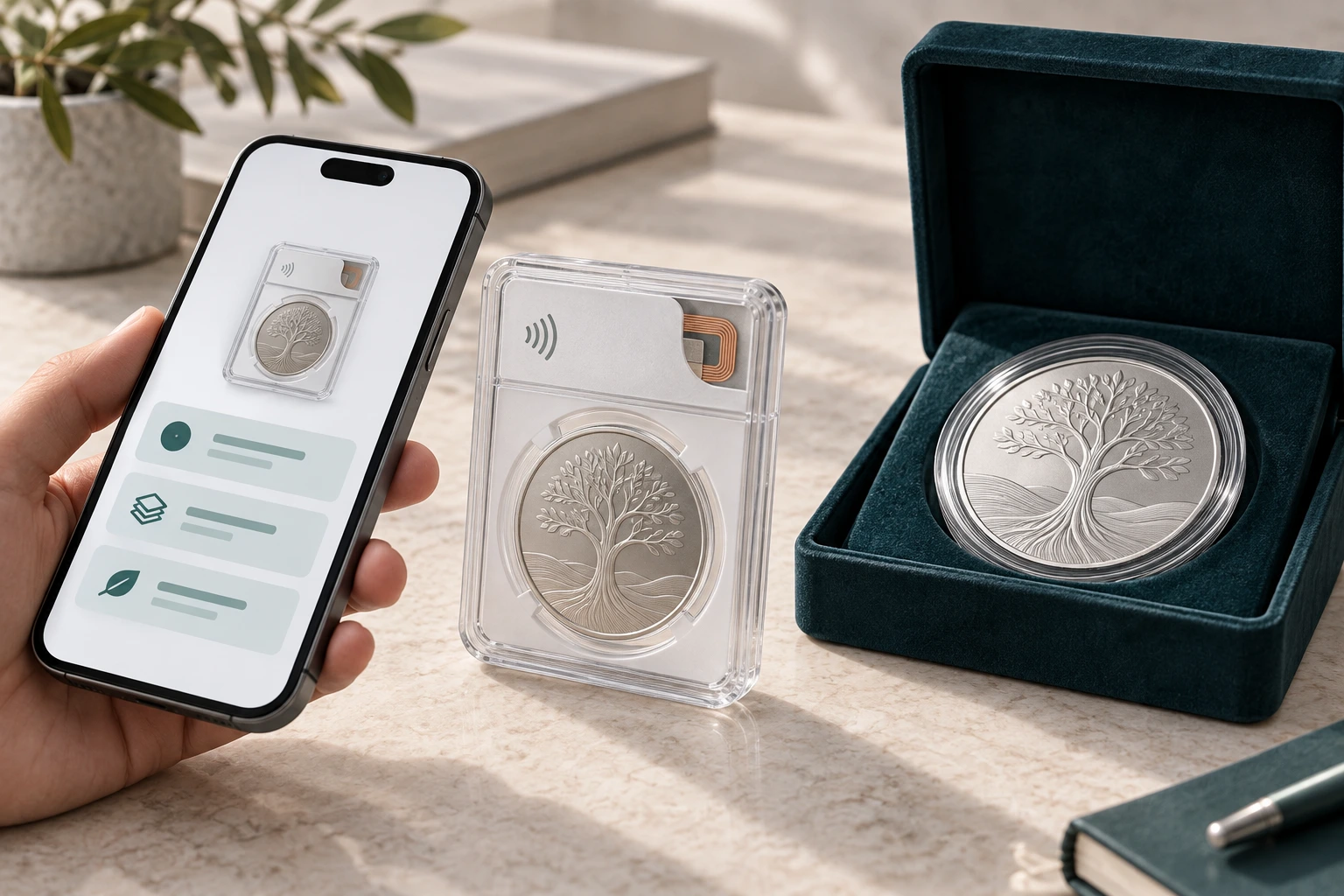
A collector buys a graded coin at auction. When it arrives, the date, type and grade on the holder match the listing, and the certification number brings up a record. One question remains: does that record belong to this particular coin and holder?
For a grading service or commemorative coin issuer, this raises a practical question. How can buyers easily find the information you have issued and compare it with the coin they receive? If the collectible is resold, where should the next buyer begin?
Secure NFC built into the protective packaging can give buyers a way to start that check from the physical item. BrandGuard provides custom tags, server verification and webpage integration to help customers offer this service with their own products.
How PCGS and NGC help buyers check the physical item
PCGS announced in October 2020 that it was extending NFC to newly encapsulated coins and other collectibles. A compatible phone opens certification details from the holder. It is an established example of delivering a verification entry point with the collectible.
NGC's Security Center advises buyers to compare certification photographs with the coin, label and holder. Auction platform GreatCollections says it inspects coins and holders for authenticity and checks for tampering.
These practices show what a useful checking process involves: receive the coin, find a reliable record, then compare the photographs, number and holder. A grading service or issuer planning its own packaging can design its customer experience around those same steps.
Use BrandGuard to take buyers from the holder to your website
If you want buyers to carry out this check on your own website, BrandGuard can link a secure NFC tag in the packaging to an individual item record and provide verification and result display. You remain responsible for the coin’s authentication, grade or issue information. BrandGuard checks the current tag read and gives the buyer access to the associated page, so you do not have to develop the tag verification backend from scratch.
The buyer holds an NFC-enabled phone near the marked position and opens the link. The browser first connects to BrandGuard’s verification server. Once the check succeeds, it redirects to your configured webpage, where the official BrandGuard component displays that result. You can also use a verification page hosted by BrandGuard.
- Read the secure NFC tagHold the phone at the marked position and open the link.
- BrandGuard checks the readThe server checks the tag information from this tap.
- See the result on the issuer's siteAfter success, the configured page opens for verification and record comparison.
Item records and website integration must be configured first. A BrandGuard-hosted page is another option. This diagram is illustrative, not a live verification result.
Alongside the tag result and time, the page can show photographs of both sides, the individual number, issue year, denomination and declared composition and dimensions. Where third-party grading is involved, authorised grading details and a link to the official certificate lookup give buyers more information to compare. They can look at the coin in front of them and work through the corresponding details on screen.
The project owner supplies and maintains these records. Connecting BrandGuard does not automatically provide access to PCGS or NGC databases. If the project uses a suitable tamper-detecting tag and packaging structure, the page can also show packaging status separately, helping the buyer decide whether to inspect further or contact the issuer.
Buyers can therefore request a verification themselves when the coin arrives. Issuers retain a place to provide information and a contact route after the product leaves them. But the page also needs to correspond to the coin in the buyer’s hands. That relationship must be established when the coin is placed in its holder and sealed, with a process suited to either grading or a new commemorative issue.
Link a graded coin to its record during encapsulation
Consider a grading service developing a holder of its own. It already has an authentication process, grades and certification numbers, and wants buyers to open the right record directly from the holder. NFC can be planned into the upper label compartment or another area that leaves the viewing window clear. The tag becomes part of the packaging.
After authentication and grading, the service creates a record with photographs of both sides, the certification number and grade, then associates it with the secure NFC tag in the holder. Once the coin is inserted, the holder sealed and the read tested, a buyer can tap the holder to open that record and compare it with the physical item.
Maintaining this relationship also means considering whether someone could open the holder and substitute another coin. If an opening alert is required on the page, the project needs a tag that supports status detection and a tamper structure designed around the opening. Actual opening tests must confirm that behaviour; the presence of NFC alone does not establish it.
Keep commemorative issue information easy for buyers to find
If you issue commemorative coins or medals, buyers may first want to check the theme, composition, specifications, edition and accompanying certificate. Those needs differ from grading, but the information still has to match the item. The U.S. Mint’s 2026 American Eagle proof issue, for example, contains one troy ounce of 99.9% silver and includes a presentation case and certificate of authenticity. It illustrates how supporting information accompanies an issue, not the use of NFC.
For a comparable series of your own, secure NFC can be incorporated into the protective holder or capsule. Create a record for each piece with its number, photographs and issue details, then associate it with the tag. Buyers can check those details on receipt and return to the issuer’s retained information if they later forget the specifications or misplace the paperwork.
First decide which part of the packaging will stay with the coin. If NFC sits only in an interchangeable gift box, the tag being verified is on that box. Removing or replacing the coin does not make the box’s result prove what is inside. Projects that need the association to remain with the collectible should therefore focus on the packaging that actually holds it and define how an opening will be handled.
Choose the NFC position and size after defining the packaging
For either a graded coin holder or a commemorative coin capsule, the earlier decisions come first: which record belongs to the item, where the buyer will tap, and whether opening detection is needed. Dimensions now answer a specific design question: where can NFC fit while preserving the view of the coin and the holder’s protective function?
Published products show why one format cannot stand in for every project. The official dimensions below are useful for initial planning. Coin diameter, external holder dimensions and space available for NFC describe different things and should be kept separate.
Swipe to view the full table
| Product or holder | Published dimensions | What is being measured |
|---|---|---|
| U.S. Mint 2026 American Eagle One Ounce Silver Proof Coin | Diameter 40.60 mm | Coin diameter, not capsule diameter |
| PCGS Standard Holder | 82.20 × 62.75 × 10 mm; maximum coin diameter 44.9 mm | Holder height × width × thickness; coin capacity listed separately |
| PCGS New Jumbo Holder | 168.275 × 129.50 × 26.20 mm; maximum coin diameter 100.9 mm | Holder height × width × thickness; coin capacity listed separately |
| NGC Medium Oversize (MSCH) | Coin diameter up to 101.5 mm; thickness up to 25 mm | Accepted coin dimensions, not external holder size |
| NGC Large Oversize (OSCH) | Coin diameter up to 120 mm; thickness up to 15 mm | Accepted coin dimensions, not external holder size |
These specifications do not establish BrandGuard compatibility with these organisations’ holders. NFC space and reading performance in your own packaging must be confirmed using drawings and samples containing the coin.
For example, a diameter of 40.60 mm helps select a capsule, but does not determine the antenna size. Inserts, printed labels and sealing borders take up space, while the distance from the metal coin affects reading conditions. Your own drawings or samples need to establish the length, width and depth available for the complete tag and the surrounding structure.
Develop and verify the design with real samples
Once the packaging requirements are clear, send BrandGuard the holder drawings or samples, available space, material requirements, maximum production temperature, closure method and desired reading distance. We use those inputs to design the antenna and select materials and manufacturing methods. You do not need to design the NFC tag first.
Next, make the sample as the buyer will receive it: insert the coin, seal the holder, then use different phones to test the reading position and reliability. Any effects from the metal, structure or manufacturing process can be addressed at this stage. Tag materials and installation also need to meet the coin’s preservation requirements while retaining the viewing area and protective function.
Finally, test the physical item and webpage together. Read a sample, check that BrandGuard’s server verifies it, and confirm that the redirect opens the correct page with the associated information and current result. BrandGuard website verification integration supports display on your own configured page, with an official plugin available for WordPress projects.
Buyers then have clear steps to follow when receiving or reselling the coin. The issuer also has a consistent information page and contact route through which to address questions about that individual collectible.
Frequently asked questions
Can another NFC tag be added to an existing PCGS NFC holder?
PCGS warns in its official security guidance that an additional NFC tag interferes with the existing one. Use the original provider's verification method. The custom applications in this article concern customers' own new packaging.
Does a successful NFC check establish the metal content or grade?
NFC verifies the secure information from the current tag read. Coin authentication, metal testing and grading remain the work of the relevant specialists. A sound application links their records to the physical coin and its packaging so buyers can consult and compare them.
Can every coin holder use the same size of NFC tag?
External dimensions alone cannot settle that. The available space for the full tag, nearby metal, sealing method and actual phone performance all matter. BrandGuard can customise the antenna, materials and process, then assess fit using samples containing the coin.
Does a buyer need the seller's old verification screenshot?
The buyer should read the tag on the item they receive and obtain a result for that read. An old screenshot, forwarded link or page refresh does not replace a new valid read. NFC verification also does not automatically transfer ownership or regrade the coin.
Plan NFC authentication for your coin packaging
Tell us which coins you issue or encapsulate, what you want buyers to check and the packaging you have in mind. Starting with real samples, we can plan the NFC design, individual item information and website verification experience together.
Discuss a coin authentication project →Sources
PCGS, NGC, GreatCollections and the U.S. Mint are independent industry references, not identified here as BrandGuard customers or partners. The BrandGuard scenarios illustrate applications for customers developing their own new packaging.
- PCGS — NFC rollout announced on 1 October 2020
- NGC — Security Center and certification image checks
- GreatCollections — Inspection of coins and holders
- U.S. Mint — 2026 American Eagle One Ounce Silver Proof Coin specifications
- PCGS — Coin holder dimensions
- NGC — Medium and large Oversize Holder capacities
- PCGS — NFC security and additional-tag warning